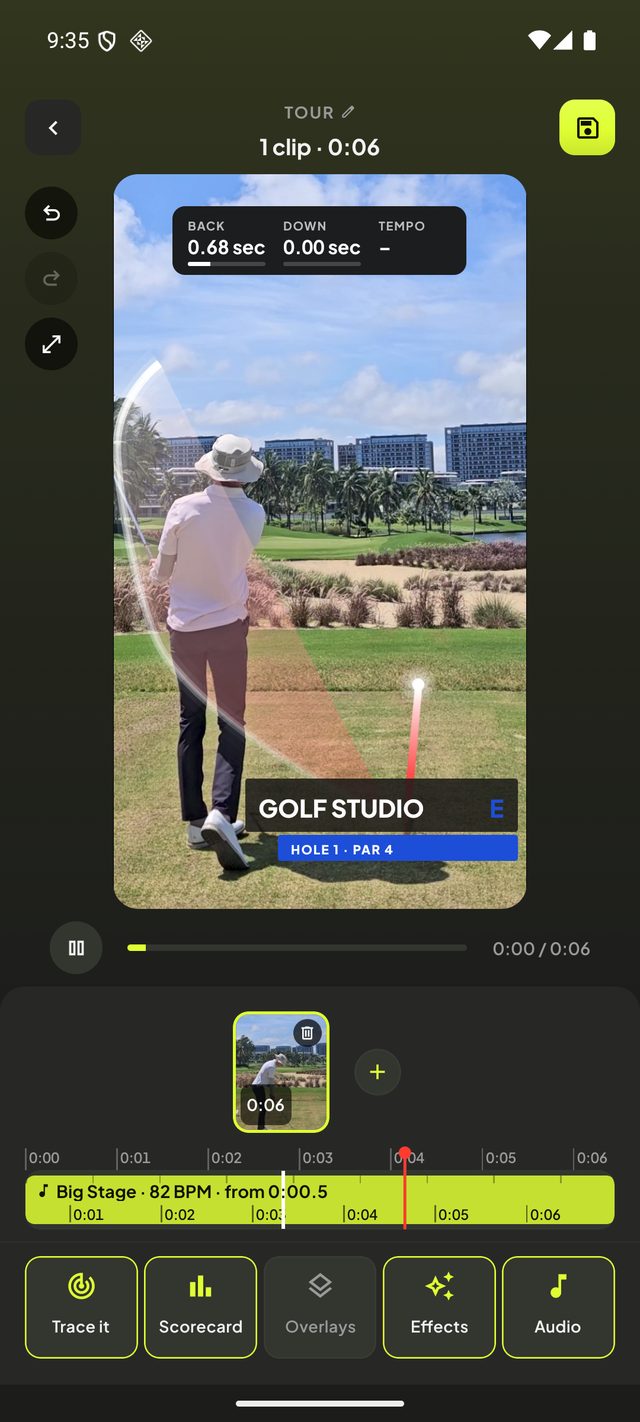
Ask a golf coach what separates a smooth swing from a snatchy one and sooner or later you'll hear the word tempo. Golf swing tempo sounds like a feel, something you either have or you don't. But tempo can be measured, and once you measure it, you can work on it.
What is golf swing tempo?
Golf swing tempo is the time your backswing takes compared with the time your downswing takes. Time the club from the moment it starts back to the top of the swing, then from the top to impact, and divide one by the other. That number is your golf tempo ratio.
It isn't the same as swing speed. A long hitter and a gentle one can share the same tempo; one simply does everything faster. Tempo is about proportion: how the two halves of the swing fit together.
What is a good golf tempo ratio?
For tour players, the answer is about three to one: the backswing takes three times as long as the downswing.
In the early 2000s, John Novosel set about timing tour players' swings from video, counting frames. His finding, published in the book Tour Tempo, was that the players were quick or slow, but the proportion held. At 30 frames a second, that meant counts like 21 frames back and 7 down, 24 and 8, or 27 and 9, every one of them 3:1.
Later 3D measurement by the Titleist Performance Institute put the tour average with a driver at around 3.2 to 1, which tells the same story. Very different golfers, very different swings, and one ratio running through them.
In real time, those tour swings are quick. A 24-and-8 swing takes about 0.8 seconds to go back and just over a quarter of a second to come down.
What your tempo ratio tells you
Club golfers often land a long way either side of three to one.
- Well above 3:1, say 4 or 5 to 1, usually means a long, slow backswing. That can feel controlled, but it often leads to a rushed, jerky change of direction at the top.
- Well below 3:1, around 2 to 1, usually means a quick, short backswing, with little time to complete the turn before the downswing starts.
So what is the ideal tempo for a golf swing? Three to one is the target, but not a verdict: tempo measures timing, nothing more, and plenty of good golfers sit a little off it. What it gives you is a number you can watch move as you practise.
How to measure your golf swing tempo
You need a video of your swing and three moments in it:
- The first move: the frame where the club starts back.
- The top: the frame where the club stops going back and starts coming down.
- Impact: the frame where the club meets the ball.
Backswing time is the top minus the first move. Downswing time is impact minus the top. Divide the first by the second and you have your ratio.
Film at 60 frames a second if you can. The downswing is so short, only six to ten frames at 30 frames a second, that being a single frame out moves the ratio noticeably. More frames means more precise marks. For the best angle and set-up, see how to film your golf swing with your phone.
A golf swing tempo app that does the maths
Golf Studio times your tempo for you. Open a clip, go to Effects and choose Tempo, then mark the three moments, stepping to each one and tapping the picture: the first move, the top and impact. The app works out the backswing, the downswing and the ratio between them, and shows them over the video in a panel that counts along as the club moves. If you've already traced the club's path with the club tracer, its marks time the swing on their own.
The times are measured in the clip's own time, so slowing the video down for a replay doesn't stretch a one-second backswing into four.
At the end of a reel, Golf Studio can give your tempo a score out of 100, from Beginner up to Tour Pro. The score is mostly about how close your ratio is to three to one, with a little credit for a backswing in the tour's range and for swings that repeat. It's generous on purpose, and honest about its limits: it rates your timing, not your technique.
Golf swing tempo drills
Knowing your number is the start. Changing it takes repetition:
- The 1-2-3 count. Say "one, two, three" on the way back and "four" at impact, keeping the counts even. It makes the backswing take three beats and the downswing one.
- Swing to a metronome. Set a metronome app to a comfortable pace and match the start, the top and impact to its clicks. Once that feels natural, quicken the beat a little and keep the proportion.
- Film, time, repeat. Time a swing at the start of a session and again at the end. Consistency matters as much as the number itself: a swing that repeats the same ratio every time is one you can trust under pressure.
Tempo won't fix a slice on its own. But a swing that holds its rhythm is easier to repeat, and a repeatable swing is the one you can improve.